
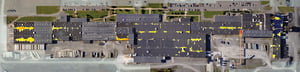

Facility managers are expected to make informed roofing decisions across increasingly large and complex portfolios. Yet one of the most significant risks to commercial roofing systems often remains hidden beneath the surface. Moisture trapped within insulation can spread undetected for months or years, reducing thermal performance, accelerating roof deterioration, and increasing the likelihood of costly repairs.
Aerial infrared roof scanning provides a non-destructive method for identifying these hidden conditions before they become visible failures. By combining aerial infrared with advanced thermal imaging technology, facility teams gain objective roof intelligence that eliminates uncertainty and supports faster, data-backed decisions.
Why Hidden Roof Moisture Is Difficult to Detect
Water intrusion does not always result in immediate leaks or visible signs of damage. Moisture can migrate beneath roofing membranes, saturate insulation, and remain concealed long before occupants notice a problem.
For enterprise facility managers, this creates several challenges:
- Limited visibility into actual roof conditions
- Difficulty prioritizing repairs across multiple facilities
- Increased uncertainty in capital planning decisions
- Higher risk of unexpected failures and maintenance costs
Traditional inspection methods often provide only a partial view of roof conditions. Visual inspections can identify surface issues, but they cannot consistently reveal moisture hidden beneath the roofing system. As a result, important maintenance decisions are frequently made without complete information.
What Is Aerial Infrared Roof Scanning?
Aerial infrared roof scanning is a roof assessment method that uses thermal imaging technology mounted on an aircraft to evaluate roof conditions across large commercial buildings and portfolios.
During the day, roofing materials absorb solar energy. After sunset, dry roofing materials release heat at a different rate than moisture-saturated materials. Because wet insulation retains thermal energy longer, these temperature differences become visible through infrared imaging.
By capturing and analyzing these thermal patterns, aerial infrared roof scanning helps identify areas that warrant immediate investigation for subsurface moisture conditions without damaging the roof system.
Unlike invasive testing methods, the process collects data quickly and efficiently while minimizing operational disruption.
Traditional assessments often struggle to deliver consistent data across large portfolios. Standardized aerial data collection enables organizations to evaluate assets at scale using a common, objective methodology.
How Aerial Infrared Supports Roof Moisture Detection
The primary benefit of aerial infrared is its ability to evaluate large roof areas rapidly while maintaining consistent data collection standards.
Potential moisture anomalies identified through thermal imaging can be:
- Located and documented across the roof surface
- Mapped to specific roof sections
- Compared across multiple facilities
- Integrated into long-term maintenance programs
This approach transforms roof moisture detection from a reactive activity into a proactive asset management strategy. Instead of waiting for leaks or visible failures, facility teams gain insight into conditions that require prioritization and validation.
The Value of Non-Destructive Roof Testing
For large commercial facilities, avoiding unnecessary disruption is critical. Non-destructive roof testing allows organizations to gather valuable condition data without introducing additional risk to the roofing system.
Key advantages include:
- No roof penetrations or destructive sampling
- Minimal impact on daily operations
- Rapid coverage of large facilities
- Consistent assessments across portfolios
- Repeatable data collection over time
Because the roof remains intact throughout the process, aerial infrared roof scanning can be incorporated into ongoing facility roof maintenance programs with minimal interruption.
Turning Infrared Roof Inspection Data Into Action
Collecting thermal imagery is only part of the process. The greatest value comes from transforming inspection findings into actionable intelligence that supports decision-making.
When used as part of a structured roof management strategy, infrared roof inspection data can help organizations:
- Prioritize repairs based on documented conditions
- Allocate maintenance budgets more effectively
- Identify high-risk areas before failure occurs
- Support long-term capital planning
- Monitor roof performance across facilities
Rather than relying solely on roof age or visual observations, decision-makers gain access to objective information that supports more strategic maintenance planning.
Why Portfolio Managers Benefit Most
The advantages of aerial infrared roof scanning become even more significant at the portfolio level.
Enterprise organizations often manage dozens or hundreds of facilities, each with different roof ages, construction types, and maintenance histories. Establishing a consistent understanding of roof condition across these assets can be challenging.
A standardized aerial infrared program provides a common dataset that enables facility managers to compare conditions across locations, identify emerging risks, and prioritize investments based on measurable information rather than assumptions.
This portfolio-wide visibility supports smarter resource allocation and helps organizations focus attention where it can have the greatest impact.
Turning Visibility Into Better Facility Roof Maintenance Decisions
Aerial infrared roof scanning provides more than an inspection snapshot. It delivers objective roof intelligence that helps facility managers understand current conditions, identify hidden moisture, and reduce uncertainty across their roofing assets.
By combining non-destructive roof testing with portfolio-scale data collection, organizations can move beyond reactive maintenance and make decisions with greater confidence. By replacing assumptions with standardized roof intelligence, organizations gain portfolio visibility, reduce uncertainty, and make defensible capital decisions with greater confidence.