
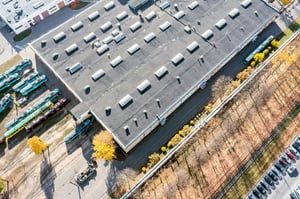

Infrared roof inspection has become a practical, portfolio-scale tool for facility owners who need clarity about roof condition without disruption. For large facilities, moisture trapped beneath the membrane is one of the most common and costly hidden risks. Left undetected, it accelerates deterioration, increases energy loss, and drives unplanned capital spending.
Infrared thermography offers a non-destructive way to surface that risk early and translate conditions into actionable repair decisions.
Why Hidden Roof Moisture Is So Hard to Spot
Water intrusion rarely presents as a visible leak, especially on commercial roof systems. Moisture can migrate laterally, collect beneath insulation, or remain trapped long before staining or interior damage appears. Traditional visual inspections and core cuts provide limited coverage and introduce their own risks.
For large facility roof maintenance programs, this creates two problems:
- Condition uncertainty across thousands or millions of square feet
- Difficulty prioritizing repairs when damage is not evenly distributed
This is where non-destructive testing methods like infrared thermography add measurable value.
How Infrared Thermography Works in Roof Moisture Detection
Infrared roof inspections rely on temperature differentials captured by thermal imaging. During the day, roofing materials absorb heat. After sunset, dry materials release that heat quickly, while wet insulation cools more slowly because moisture retains thermal energy.
An experienced thermographer scans the roof surface during optimal conditions and identifies anomalies that indicate potential moisture presence beneath the membrane. These patterns are not assumptions about failure. They are indicators of elevated risk that warrant targeted action.
Key advantages include:
- No penetrations or damage to the roof system
- Rapid coverage of large roof areas
- Clear visual documentation tied to specific locations
Because the process is non-invasive, operations below the roof remain uninterrupted.
From Thermal Images to Decision-Grade Data
Thermal images alone do not solve problems. The value of infrared roof inspection comes from how findings are interpreted, validated, and translated into maintenance strategy.
A structured infrared program typically includes:
- Thermal scans mapped to roof drawings or GIS systems
- Classification of anomalies by size, severity, and location
- Selective verification where needed to reduce uncertainty
- Documentation consistent across facilities and years
This transforms roof moisture detection from a one-time diagnostic into a repeatable data set. Over time, facility owners gain a clearer picture of how conditions evolve and where risk is accumulating.
Supporting Risk-Based Roof Repair Prioritization
For enterprise portfolios, the goal is not to eliminate all defects immediately. The goal is to reduce risk in a predictable, defensible way.
Infrared thermography supports roof repair prioritization by helping teams:
- Distinguish isolated moisture areas from systemic issues
- Allocate budgets toward the highest-risk sections first
- Avoid premature full replacements when targeted repairs are sufficient
- Plan capital projects with greater confidence
Rather than relying on age alone, decisions are informed by actual condition indicators. This aligns maintenance spending with risk exposure, which is especially critical when managing dozens or hundreds of facilities.
Why Portfolio-Scale Programs Benefit Most
Infrared roof inspection scales efficiently. Large roofs and multi-site portfolios benefit from consistent methodology, standardized reporting, and comparative analysis across assets.
For owners responsible for warehouses, manufacturing plants, distribution centers, or campus-style facilities, infrared thermography creates a common language between facilities teams, finance, and leadership. Conditions are visual, measurable, and easier to explain when prioritization decisions are reviewed.
Just as importantly, inspection results provide documentation that supports proactive stewardship. Identifying moisture early helps extend roof service life and reduces the likelihood of disruptive failures.
Turning Visibility Into Action
Infrared roof inspections do not replace sound roofing programs. They strengthen them. By revealing hidden moisture without destructive testing, infrared thermography gives facility owners earlier visibility into risk and a clearer basis for action.
When used as part of a disciplined inspection strategy, infrared roof inspection supports smarter maintenance decisions, controlled capital planning, and reduced uncertainty across large facility portfolios.