
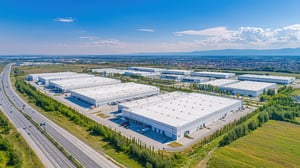

Enterprise facilities rarely fail from what is visible. Risk accumulates in places that are difficult to inspect at scale, especially within multi-layer roofing systems. Infrared roof inspection, a form of non-destructive testing, changes how facility teams identify and act on hidden moisture by converting thermal data into clear, risk-based repair priorities.
This approach replaces guesswork with defensible decisions, supporting asset protection, budgeting accuracy, and long-term portfolio performance.
Turning Thermal Data Into Actionable Roof Moisture Intelligence
Infrared thermography measures temperature differentials across a roof surface. Wet insulation retains heat differently than dry materials, creating detectable anomalies after sufficient solar loading.
For large facilities, this technique produces far more than an image. It generates roof moisture intelligence that includes:
- Location-specific moisture signatures
- Estimated saturation levels
- Pattern recognition across assemblies and sections
- Change detection compared to previous inspections
Because the method is non-invasive, it preserves system integrity while delivering comprehensive coverage.
The outcome is a dataset that supports consistent decision-making across portfolios, rather than isolated, subjective observations.
Establishing Clear Decision Thresholds
Raw thermal imagery alone does not drive repairs. The value comes from applying standardized thresholds that translate moisture detection into priority levels.
Typical classification frameworks include:
Priority 1: Immediate Risk
- Large, contiguous wet areas
- Active intrusion likely, or already confirmed
- High potential for interior impact or accelerated membrane failure
Recommended action: Immediate targeted repairs or sectional replacement
Priority 2: Elevated Risk
- Moderate moisture spread
- Localized degradation trends
- No current interior damage, but progression likely within one season
Recommended action: Scheduled repair in the near-term capital plan
Priority 3: Monitor and Defer
- Small, isolated anomalies
- Early-stage moisture presence
- Stable condition with no active expansion
Recommended action: Monitor through repeat infrared thermography scans
By aligning thresholds with risk tolerance, facility leaders create consistency across buildings and geographies. This is critical for enterprise-scale roof repair prioritization.
Workflow Integration Across Large Facilities
A structured workflow ensures that insights from infrared roof inspection translate into measurable outcomes.
Inspection and Data Capture
Aerial thermography technicians conduct nighttime scans following appropriate thermal loading conditions. Data is collected alongside visual inspection findings to validate anomalies.
Data Validation and Mapping
Thermal anomalies are correlated with roof plans, core samples when needed, and system details. Each finding is geolocated and categorized.
Quantification
Moisture areas are measured and expressed as a percentage of the total roof section or building area. This step connects conditions directly to asset value and replacement cost.
Risk Scoring
Each anomaly is scored using predefined criteria:
- Size and concentration
- Proximity to seams, penetrations, or drains
- Evidence of progression
- Impact on operations
Portfolio-Level Prioritization
Sites are ranked against one another, not just within individual buildings. This allows capital to be allocated where it delivers the highest risk reduction.
Targeted Repair Planning
Rather than full replacement, repairs are scoped to address only affected areas, extending service life and reducing unnecessary spend.
Real-World Application Example
A national distribution portfolio with 40 large-format facilities implemented infrared thermography to improve capital planning.
Before inspection
- Repairs were reactive
- Budget allocations were evenly distributed, not risk-based
- Moisture conditions were largely unknown until failure
After implementation
- 18 percent of total roof area showed moisture presence, but only 4 percent qualified as high risk
- Immediate repairs were focused on five facilities with concentrated saturation near critical operations
- Moderate-risk areas were scheduled over two fiscal cycles
- Low-risk areas were monitored, avoiding premature replacement
Outcome
- Significant reduction in emergency repairs
- Improved allocation of capital
- Extended life of multiple roofing systems
This is the practical impact of structured roof moisture intelligence.
Why Non-Destructive Testing Matters at Scale
Traditional inspection methods often rely on sampling, which introduces uncertainty when applied across large surfaces. In contrast, non-destructive testing through infrared:
- Covers 100 percent of the roof area
- Minimizes disruption to operations
- Provides repeatable, comparable datasets over time
- Supports trend analysis and lifecycle planning
For enterprise portfolios, consistency is as important as accuracy. Infrared thermography delivers both.
Aligning Roof Strategy With Risk Reduction
For facility and asset managers, the goal is not simply to find moisture. It is to reduce exposure, extend asset life, and improve budget predictability.
Aerial Infrared roof inspection practices enables:
- Early detection of hidden failures
- Objective prioritization across multiple sites
- Data-backed capital planning
- Reduced total cost of ownership
When integrated into an ongoing inspection program, it transforms roofing from a reactive expense into a managed asset category.
Final Takeaway
Infrared thermography is not just a diagnostic tool. It is a decision framework.
By combining comprehensive moisture detection, standardized thresholds, and portfolio-level analysis, facility teams can move from uncertainty to precision. The result is smarter roof repair prioritization, reduced risk, and measurable performance gains across large-scale operations.