
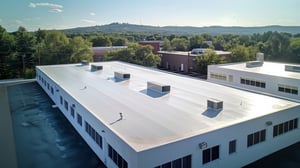

For organizations managing large building portfolios, roof performance is a portfolio-wide risk management challenge. Hidden moisture intrusion, thermal anomalies, and aging roof systems can accelerate deterioration long before visible signs appear.
Portfolio-grade aerial infrared roof inspections help solve this challenge by converting complex thermographic data into standardized roof health scores. These programs provide consistent visibility across hundreds or thousands of facilities, supporting more accurate capital planning, repair prioritization, and long-term risk management.
Why Traditional Roof Assessments Fall Short at Portfolio Scale
Traditional roof inspections often rely on visual observations, sample testing, or reactive leak investigations. While effective for individual buildings, they can create challenges across large portfolios:
- Inconsistent inspection methods between sites
- Limited visibility into subsurface moisture conditions
- Difficulty comparing roof conditions across assets and regions
- Reactive maintenance driven by leaks rather than early indicators
Traditional roof assessments were designed for individual buildings. They do not scale effectively across large portfolios. Organizations need standardized roof intelligence, not isolated inspection reports.
Without standardized data, facility teams often struggle to prioritize repairs, forecast budgets, and communicate roof risk effectively.
Comparing Roof Assessment Methods
Walkover Inspections
- Identify visible defects and maintenance concerns
- Results may vary between inspectors
- Limited ability to detect hidden moisture
Core Cuts and Sample Testing
- Verify roof conditions in specific locations
- Require destructive testing and repairs
- Provide only a limited snapshot of overall conditions
Aerial Infrared Analysis
- Non-destructive, full-roof coverage
- Detects thermal anomalies associated with trapped moisture
- Uses a standardized methodology across facilities
- Creates consistent data for portfolio-level comparisons and decision-making
How Portfolio-Grade Aerial Infrared Analysis Works
Aerial infrared scanning is typically performed after sunset, when roof systems release heat absorbed during the day. Moisture-saturated materials cool at different rates than dry materials, creating thermal patterns visible in infrared imagery.
This process enables organizations to:
- Assess entire roof systems without disrupting operations
- Identify hidden moisture conditions early
- Collect consistent data across multiple facilities
- Document roof conditions objectively for maintenance and capital planning
When anomalies are identified, targeted field verification can be performed to support repair planning.
Converting Data Into Roof Health Scores
The greatest value comes from transforming roof condition data into standardized portfolio intelligence that supports defensible capital decisions.
By combining thermographic data, visual observations, roof age, repair history, and condition trends, organizations can classify assets into actionable categories:
- Repair Priority – Elevated risk requiring near-term attention
- Monitor Priority – Conditions that warrant observation and planned maintenance
- Replacement Priority – Significant deterioration requiring capital planning
This standardized framework helps facility leaders compare assets consistently, prioritize resources, and track roof performance over time.
Prioritizing Repairs and Forecasting Capital Spend
Rather than reacting to leaks or relying solely on roof age, organizations can target resources where data indicates the greatest risk.
Standardized reporting supports:
- More effective repair prioritization
- Reduced likelihood of unexpected roof failures
- Better alignment between maintenance activities and actual conditions
- More accurate multi-year capital planning
- Clearer communication with finance and executive leadership
Early intervention often allows smaller repairs, reduces business disruption, and helps extend roof service life.
Supporting Long-Term Roof Intelligence Strategies
When repeated over time, aerial infrared inspections become a powerful performance-tracking tool.
Organizations can:
- Monitor changes following repairs
- Validate maintenance investments
- Identify recurring issues across facilities
- Improve long-term planning consistency
- Reduce unnecessary roof replacements through condition-based decision-making
Seeing the Portfolio, Protecting the Assets
Portfolio-grade aerial infrared roof inspections provide the consistent, objective intelligence needed to reduce uncertainty across large commercial portfolios. By converting thermographic findings into actionable roof health scores, organizations gain greater confidence in repair prioritization, capital forecasting, and long-term asset management.
The result is greater portfolio visibility, quantified roof condition, and more defensible capital decisions. Organizations replace assumptions with objective data, reduce uncertainty, and gain confidence in every roof-related decision.