
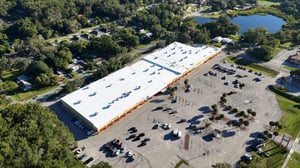

Large flat-roof portfolios present a unique challenge – failures rarely announce themselves at the surface. By the time leaks are visible inside a facility, damage is already widespread. A non-destructive infrared roof inspection changes that dynamic, providing objective, building-wide visibility into hidden conditions without cutting into the assembly.
This RAM Companies insight outlines how thermal imaging works, why traditional inspections fall short, and how facility leaders can use verified data to guide repair-versus-replace decisions and capital planning.
Why Traditional Flat Roof Inspections Miss Critical Issues
Standard walkthroughs and visual flat roof inspections rely heavily on surface clues – ponding water, membrane damage, flashing conditions, and visible seams. While important, these indicators rarely correlate directly with moisture trapped below the membrane.
Key limitations include:
- Subsurface blindness – Visual inspections cannot detect moisture beneath insulation layers
- Delayed symptom visibility – Interior leaks appear far from failure points and often long after saturation begins
- Sampling bias – Core cuts or probes only assess isolated areas, not the entire roof
- Subjective assessments – Inspector experience influences conclusions, reducing consistency across large portfolios
For enterprise-scale facilities, these gaps lead to reactive maintenance, inflated repair costs, and premature replacement decisions.
How Non-Destructive Infrared Roof Inspection Works
A thermal imaging roof survey identifies hidden moisture by detecting temperature differentials across the roof surface. The process is rooted in how wet insulation behaves compared to dry materials.
Step 1 – Optimal Survey Conditions
Thermal surveys are performed after sunset following a sunny day. During daylight hours, the roof absorbs solar energy. After sunset:
- Dry insulation cools rapidly
- Water-saturated areas retain heat longer
This difference creates detectable thermal patterns.
Step 2 – Infrared Scanning of the Roof Surface
Technicians scan the entire roof field using calibrated infrared cameras. These devices capture temperature variations not visible to the human eye.
- Warmer zones typically indicate moisture intrusion
- Cooler, uniform areas generally indicate dry insulation
This creates a full-field diagnostic map rather than isolated observations.
Step 3 – Correlation and Ground-Truthing
Thermal anomalies are verified through selective validation methods such as:
- Moisture meters
- Core samples at targeted locations
- Visual confirmation at identified hot spots
This step ensures data accuracy while minimizing destructive testing.
Step 4 – Mapping and Documentation
Results are compiled into a detailed report, including:
- High-resolution thermal images
- Moisture boundary mapping
- Quantified wet versus dry areas
- Annotated roof plans
This transforms raw data into actionable intelligence for roof condition assessment for large facilities.
Applications for Hidden Roof Leak Detection
Infrared surveys excel at locating issues that are otherwise undetectable until failure escalates.
Common findings include:
- Entrapped moisture beneath intact membranes
- Insulation saturation from long-term minor leaks
- Compromised seams not visible at surface level
- Moisture migration far from original entry points
For large flat roofs, this capability enables precise hidden roof leak detection across millions of square feet without disruption to operations.
Turning Diagnostics Into Decisions
The true value of a non-destructive infrared roof inspection lies in how the data is applied. For facility managers overseeing large portfolios, objective insights eliminate guesswork.
Repair Versus Replace – Defining the Threshold
Thermal imaging enables quantified decision-making based on saturation levels:
- Localized moisture – Targeted repairs can extend roof life at a fraction of replacement cost
- Moderate spread – Sectional replacements may be justified
- Widespread saturation – Full replacement becomes the most cost-effective option
Instead of defaulting to full tear-offs, organizations can prioritize only what is necessary.
Capital Planning and Budget Forecasting
With verified moisture mapping, facility leaders can:
- Forecast remaining service life by roof section
- Phase capital expenditures across budget cycles
- Align roofing investments with broader asset management strategies
- Avoid emergency spend driven by unexpected failures
This elevates roofing from a reactive maintenance line item to a controlled capital program.
Portfolio-Level Standardization
For multi-site operators, consistent facility maintenance diagnostics create comparability across assets:
- Standardized inspection methodology
- Uniform reporting outputs
- Scalable decision frameworks
This consistency is critical for enterprise risk management and long-term planning.
Strategic Advantages for Large Facilities
Implementing thermal imaging roof surveys delivers measurable benefits across operations and finance:
- Reduced lifecycle costs – Repair only what is needed, when it is needed
- Minimized disruption – No invasive testing or operational downtime
- Improved risk mitigation – Identify issues before interior damage occurs
- Data-driven planning – Replace assumptions with objective evidence
For facilities with large contiguous roof areas, even small undetected failures can scale into significant liabilities. Early detection dramatically reduces that risk.
Elevating Roof Asset Management
A thermal imaging roof survey is not just an inspection – it is a strategic diagnostic tool. When deployed consistently across large flat-roof portfolios, it provides the clarity needed to move from reactive response to proactive, data-driven asset management.
By leveraging non-destructive infrared roof inspection, enterprise facility owners gain:
- Full visibility into subsurface conditions
- Confidence in repair-versus-replace decisions
- A defensible foundation for capital planning
In an environment where roof performance directly impacts operational continuity, this level of precision is not optional – it is essential.