
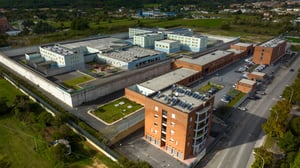

How Fixed-Wing Aerial Data Collection Creates Greater Roof Visibility in Secure-Sensitive Environments
Correctional facilities operate under security requirements unlike most commercial properties. Access is controlled, movement throughout the facility is closely managed, and technologies used around the perimeter can introduce additional security considerations.
Those requirements can make something as routine as assessing roof conditions significantly more complicated.
Facility teams still need objective data to understand roof conditions, identify potential areas of concern, and prioritize capital decisions. The method used to collect that data matters.
For correctional systems, fixed-wing aerial infrared creates a scalable approach to collecting consistent roof data while reducing many of the access and security challenges associated with traditional methods and low-altitude drone operations.
The Challenge of Roof Data Collection in Secure Environments
Correctional campuses can include administrative buildings, housing units, medical facilities, dining operations, maintenance buildings, and other structures contained within a secured perimeter.
Collecting consistent roof data across these facilities can require significant coordination. Personnel may need special authorization and escorts, while equipment brought onto the property may need to comply with strict security procedures.
At the same time, roof-related risk does not disappear because access is difficult.
Moisture can become trapped beneath a roof membrane long before visible leaks occur. Without objective condition data, facility leaders may be forced to make capital decisions based primarily on roof age, leak history, or surface-level observations.
For a correctional system, the goal is clear: gain better roof visibility without unnecessarily increasing activity inside the secured environment.
How Aerial Infrared Creates Greater Roof Visibility
During the day, roofing materials absorb energy from the sun. As the roof cools after sunset, areas containing trapped moisture can retain and release heat differently than surrounding dry materials.
Specialized infrared technology captures these temperature differences, allowing thermal anomalies associated with potential moisture conditions to be identified for further investigation.
The resulting data creates greater clarity around where potential concerns exist across the roof.
Instead of relying primarily on roof age, leak history, or assumptions, facility teams gain objective data to focus further investigation where it matters most.
Consistency Matters at Scale
A single roof can be evaluated in isolation. A correctional system requires something more.
Standardized aerial data collection creates a consistent view across buildings, campuses, and facilities. That consistency gives decision-makers a stronger foundation for comparing conditions, prioritizing potential risk, and determining where capital attention is needed most.
Why Fixed-Wing Collection Fits Secure Facilities
For correctional systems, the value of fixed-wing aerial infrared extends beyond efficiency.
A Different Approach to Low-Altitude Drone Collection
Where drone flights are restricted, prohibited, or inconsistent with facility security protocols, fixed-wing aerial collection provides another option for acquiring roof-condition data, subject to applicable aviation and facility requirements.
More Focused Investigation
Aerial infrared identifies potential areas of concern before targeted field validation occurs. The resulting data allows teams to focus subsequent investigation on areas that warrant greater attention.
Portfolio-Scale Visibility
Correctional systems often manage more than one building or institution. Fixed-wing aerial collection can capture large facilities and multiple properties efficiently, helping create consistent roof-condition information across a broader portfolio.
Non-Destructive Data Collection
Infrared thermography evaluates thermal patterns across the roof without requiring destructive testing as the initial method of identifying potential moisture-related areas.
Data-Backed Decision-Making
When facility leaders gain greater visibility into potential moisture-related concerns, they can prioritize further investigation and capital attention based on condition data rather than assumptions.
From Individual Facilities to Portfolio Visibility
The advantage becomes even greater for state agencies, private correctional operators, and other organizations responsible for multiple facilities.
Looking at properties individually makes it difficult to understand how roof conditions and potential risk compare across an entire system.
Standardized roof data creates a consistent foundation for comparing assets across the portfolio.
Instead of prioritizing a roof simply because it is the oldest, facility leaders can incorporate actual condition data into the decision-making process.
That can help teams answer more meaningful questions:
- Where are potential moisture-related conditions occurring?
- Which roofs warrant additional investigation?
- Where should capital attention be prioritized?
- Which assets represent the greatest potential roof-related risk?
- Which roofs may not require the immediate capital investment previously assumed?
The result is a clearer path from standardized roof data to more defensible capital decisions.
Why Drones Are Denied Access Above Correctional Facilities
Unauthorized drone activity is a recognized security concern for correctional facilities, and drone operations may be prohibited or heavily restricted depending on the facility, jurisdiction, and surrounding airspace. Even where an authorized operation may be possible, site-specific approvals and security protocols can make low-altitude drone collection impractical.
This creates an important distinction between low-altitude drone collection and RAM Companies’ fixed-wing approach.
RAM Companies uses fixed-wing aircraft equipped with specialized infrared technology to capture consistent roof-condition data at scale.
Rather than depending on a drone operating directly within or immediately above a secured property, fixed-wing aerial collection provides a different approach to gathering roof intelligence across large, security-sensitive facilities.
Security and Visibility Do Not Have to Compete
Correctional facilities should not have to choose between maintaining strict security protocols and gaining better information about their physical assets.
Fixed-wing aerial data collection addresses both priorities.
By collecting standardized roof data from above, RAM Companies gives correctional facility leaders greater visibility into potential roof-related risk across individual facilities and entire property portfolios.
When access is complex and security is critical, roof decisions should not depend on assumptions.
When every decision must account for security, the way roof data is collected matters.
Gain Greater Roof Visibility Across Security-Sensitive Facilities
See how RAM Companies’ delivers standardized roof data at scale to support risk prioritization and more informed capital planning across correctional facility portfolios.